
A Beekeepers Perspective: 7 Things To Think About if You Want Bees
Hey there friends! You may remember a few weeks ago when I wrote about my brother-in-law bringing his backyard bees to our property. I’m happy to report that they have settled in and are happily pollinating away.
After reading some of the comments that were left on that post, my brother-in-law (who we’ll now call “Zack The Bee Man”) thought it would be good to write a guest post to clear up some misconceptions or myths about beekeeping and list some of the amazing benefits of keeping bees as well as some fun facts about honey bees. He might be a fairly new beekeeper, but he knows his stuff!
Take it away, Zack The Bee Man:

First let me say that I subscribe to An Oregon Cottage and have been a follower for many years (ahh, thanks, Zack!) When my hives were mentioned here a few weeks ago, I enjoyed reading all the comments and wanted to give more information about keeping bees:
7 important considerations if you are interested in keeping bee hives of your own:
1. Many people commented on how much time it would take to be a beekeeper. In reality, the less you open the beehive and disturb the bees, the better off and more productive they will be. Hive inspection should last between 10 and 15 minutes and be done no more than 6 to 8 times a year. Obviously a couple hours will be spent harvesting all the honey on a hot day towards the end of August (in the Willamette Valley). But the harvest time is exciting and time seems to fly by with every frame of honey that is “spun out” in a honey extractor and collected in jars to be enjoyed all year long.
2. Another myth about bees is that they are dangerous. People unfortunately often group honeybees in the same category as wasps, hornets and yellow jackets. Honey bees are inherently a docile insect. Their last intention is to sting someone. They sting out of defense and will not “attack” an innocent bystander.
3. Honeybees are vital to our food supply. Roughly 60% of the fruits and vegetables we rely on to feed our families need honey bee pollination.
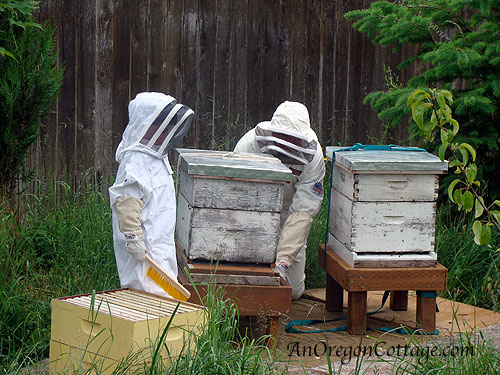
4. Honeybees need our help. In recent years, millions of colonies of wild honeybees have been wiped out by urbanization, pesticides, parasitic mites and a recent phenomenon called “Colony Collapse Disorder.” Backyard beekeeping has become vital in our efforts to reestablish lost colonies of bees and offset the natural decrease in pollination by wild bees.
5. The pollen and honey have medicinal properties: bee pollen is high in protein and can be used as a homeopathic remedy for seasonal pollen allergies. And for centuries, honey has been used as an antibacterial medicine and is still used throughout the world in burn units for healing.
6. The financial benefits of being a backyard beekeeper can be significant. Initial investment can be around $200 to $400 per hive, but each hive can produce up to 60 to 90 pounds of honey every year. Raw honey can be sold for $5 to $7 per pound (60 x 5 = $300, which makes up the cost of the hive in the first year).
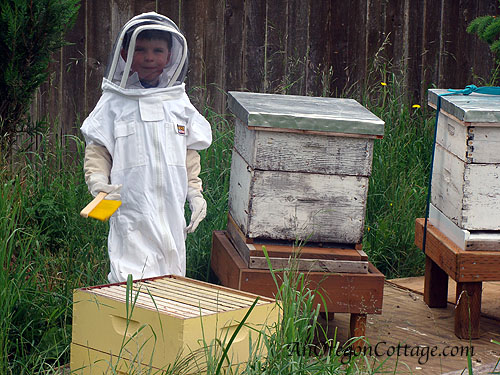
7. Beekeeping is a great learning tool for children. My son, age 5, loves taking care of “his girls”. He has his own bee suit and looks forward to inspecting the hives and watching the bees build honeycomb and examining all the capped brood and honey in the frames.
A Few More Fun Facts About Honeybees
- The honey bee’s image became a symbol of kings and religious leaders and was honored on ancient coins and in mythology
- The Romans used honey to pay for their taxes
- Honey found in the tombs of the Egyptian Pharaohs was still edible after 5,000 + years
- To produce 1 lb of honey, the bees must visit 2 million flowers
- Bees fly in about a 3 mile radius to collect pollen and nectar to bring back to the hive
- The average worker bee produces about 1/12th teaspoon of honey in her lifetime
- A honey bee visits 50 to 100 flowers during a collection trip
- The Queen Bee will live from 3 to 5 years and lays up to 2500 eggs a day (more than her body weight)
- The term “honeymoon” was coined when newlyweds were encouraged to drink mead (honey wine) for one month (one phase of the moon) to assure the birth of a son
Thanks, Zack – wow, that is a lot of information! Anyone want to become a beekeeper, now? Oh, and if you have any questions for Zack, leave a comment below for him and he’ll be sure to answer.

I read somewhere that we had to feed the bees and do hours and hours of maintenance in order to keep bees… so since we don’t have time for another project of that scope, we have not pursued beekeeping. I have put the Beekeeping for Dummies on hold at the library… do you know if there is an inexpensive or creative way to get ourselves a few hives? Maybe care for somebody else’s hives for a year and they’d give us the hives and keep the honey after a year? Probably not???
Well, my brother-in-law did a follow-up post after the hives he paid for didn’t make it through the winter, so he harvested wild bees from an old barn being torn down: https://anoregoncottage.com/bee-update-harvesing-wild-bees/
Not for the faint of heart though, Rachel! He does feed the bees occasionally, and there are times he’s here for a while, but it definitely isn’t hours and hours – you want the bees to do their own thing. 🙂